Cation tank + anion tank
Two tanks, each doing one job. Water passes through the cation tank, then the anion tank, so it is treated once by each resin type.

Why two mixed-bed tanks in series can be a better choice than a single tank: fuller resin use, scheduled swaps and lower risk of out-of-spec water.
Talk to an EngineerTwo tanks, each doing one job. Water passes through the cation tank, then the anion tank, so it is treated once by each resin type.
Cation and anion resin are blended in the same tank, so both jobs happen at the same time. Water contacts both resins many times as it passes through, which typically produces higher-purity water.
Mixed-bed vs. two-bed white paper →Everyday comparison: it is like cleaning a window. The two-tank system wipes it once with one cloth and once with another. The mixed bed wipes it many times, with both cloths at once.
A worker/polisher (also called lead/lag) setup places two mixed-bed tanks in series. Water flows through the worker first, which removes most of the contaminants. The polisher then captures whatever passes through.
Incoming water → Tank 1 (worker) → Tank 2 (polisher) → treated water
| Factor | Single mixed-bed tank | Worker/polisher (two tanks) |
|---|---|---|
| Arrangement | One tank | Two tanks in series |
| Protection after the first tank breaks through | None | Polisher continues to treat the water |
| Resin use | Changed at or before breakthrough | Worker can run to exhaustion |
| Swap timing | Driven by breakthrough | Can be scheduled |
| Equipment | One tank | Two tanks and additional piping |
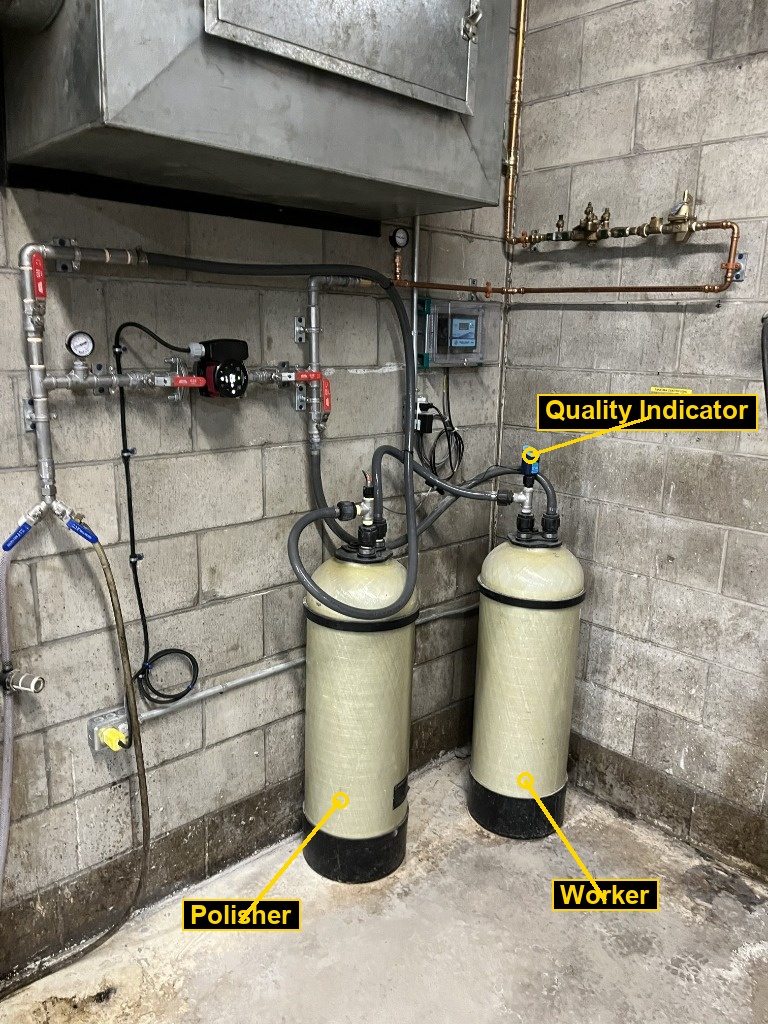
Two mixed-bed tanks in series provide high-purity water, make fuller use of each tank and let swaps be planned instead of urgent. Actual water quality, resin life and cost depend on feed water, usage, equipment and operating settings.
Related: DI tank exchange service · How service deionization works · Request an assessment